For a five-player Pokémon tournament, a single round robin gives everyone four opponents across five rounds. Run two battles at a time while one player rests. That produces 10 group matches, followed by one final between the top two players. A bye is a scheduled rest, not a win.
Below is a complete schedule you can copy, plus the decisions that keep a small online event from getting stuck: how to rank tied players, what to do when a match overruns, and how to record a disputed result. This is a reusable planning example, not an announcement or an official Pokémon competition ruleset.
Copy this five-player round-robin schedule
Assign the five confirmed players the letters A through E. Keep those letters fixed for the whole event.
| Round | Battle 1 | Battle 2 | Resting |
|---|---|---|---|
| 1 | A vs B | C vs D | E |
| 2 | E vs B | A vs C | D |
| 3 | E vs D | B vs C | A |
| 4 | E vs C | D vs A | B |
| 5 | E vs A | D vs B | C |
| Final | 1st vs 2nd | — | — |
Every pair appears exactly once. Each player battles four times and rests once. The arithmetic is 5 × 4 ÷ 2 = 10: counting four opponents for each of five players counts every match twice, so divide by two.
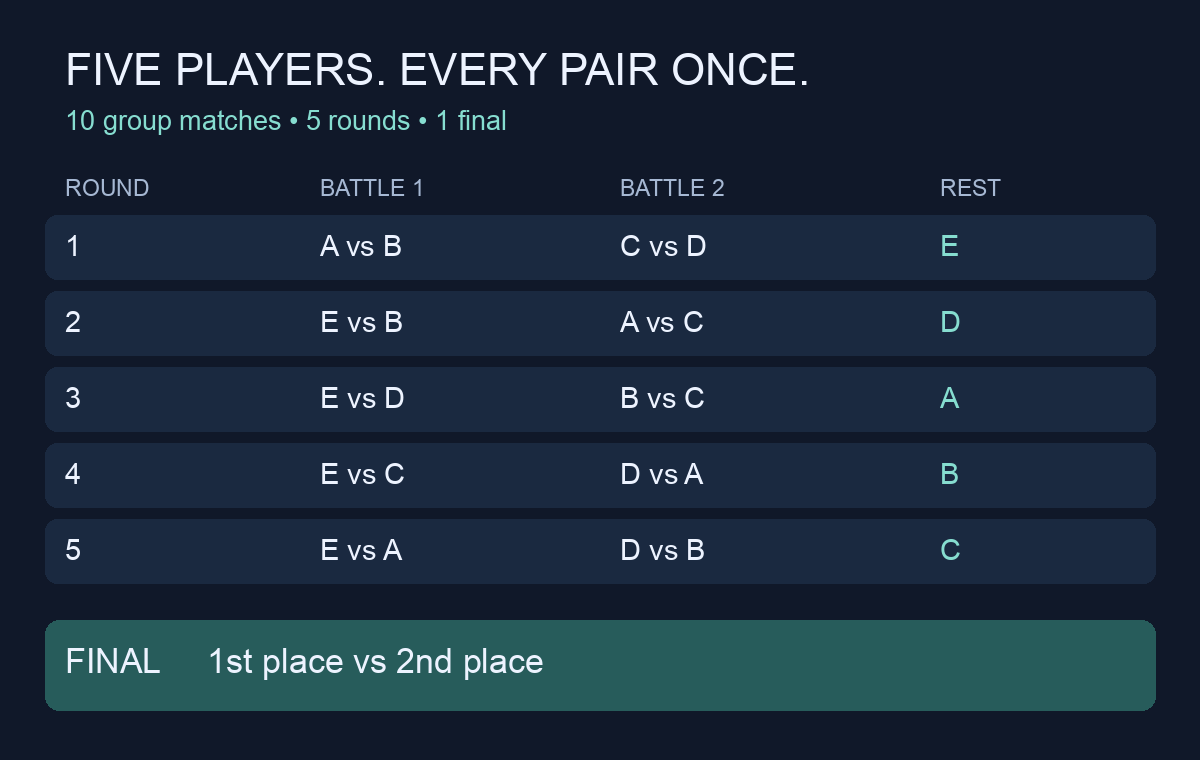
An original scheduling diagram. Letters are placeholders, not player names or recorded results.
Two simultaneous battles need two separate sessions. A five-person tournament does not mean five players connect to one game room. For Pokémon Quetzal online multiplayer, keep the game setup guide separate from the tournament schedule. First prove that each pairing can enter the intended battle mode; then start counting competitive results.
If a sixth person joins, stop and rebuild the schedule before play. Six players require 15 group matches if everyone is to face everyone once. Adding that player only to spare bye slots in the table above would leave some pairings missing.
Budget time for rounds, not just individual battles
With two battles running together, a round lasts as long as its slower match. Ten group matches do not require ten consecutive slots, but five rounds still need time for joining rooms, reporting results, and breaks.
For example, reserve a 60-minute slot per round: 45 minutes for setup and play, then 15 minutes for reporting and a break. That is a planning allowance, not evidence that a six-on-six battle will finish within 45 minutes. Test the format with the actual game release and devices before promising an end time.
A two-day plan could place rounds 1–3 on Saturday and rounds 4–5 on Sunday, followed by standings review, any playoffs, and the final. Under the illustrative one-hour slots, that is three hours of group-round scheduling on Saturday and two on Sunday. The final and playoffs need additional time.
Publish a separate check-in time before the first round. Players should already have the correct game release, battle settings, and team ready. If someone has a first-round bye, tell them when their first actual match starts rather than expecting them to infer it.
Write the overrun rule in advance. For a friendly event, one option is to let the current battle finish and announce a delay. If you want a hard limit, specify the exact in-game adjudication method before the event. Do not invent a winner because a calendar slot has ended.
Give every start time a date and a time zone
“Saturday at 6:30” is incomplete for an international group. Include the calendar date, the time, and the reference offset, or use a platform timestamp that converts for each viewer.
For example, 18:30 UTC+6 is 12:30 UTC, 18:00 UTC+5:30, and 19:30 UTC+7 on the same date. Avoid one generic “Europe time” column: players need their actual local zone and the applicable seasonal offset.
Ask each participant to confirm the schedule or identify a specific conflicting round. A reaction to the event announcement is not necessarily agreement to all five round times. If two opponents reschedule, put their new time beside that match and check that neither player is already assigned elsewhere.
Decide tied standings before anyone wins a match
A simple scoring proposal is one point for a win, zero for a loss, and zero for a bye. Unfinished or disputed matches remain pending, rather than silently becoming a loss.
For two players tied on points, their head-to-head result can decide the order if that rule was announced beforehand. Three-way ties need more care.
Consider A, B, and C all finishing on three wins. A beat B, B beat C, and C beat A; each also beat D and E. All three have the same overall record and one win within the tied group. “Use head-to-head” has not selected two finalists.
One workable policy is:
- Compare wins in matches between the tied players.
- If the qualifying places are still unresolved, run a playoff using the previously agreed format.
- If that playoff also produces a circular tie, use a fallback published before play, such as a randomly seeded knockout playoff with a drawn bye. Explain that the bye introduces a luck element; choose another method if the group does not accept it.
This is an organizer's proposed policy, not a universal competitive standard. Agree on it with the players and allow enough time. A scheduled final cannot start fairly while its participants are still undecided.
Freeze the rules sheet, not the conversation
Keep one dated rules message that everyone can find. It should specify the exact game release, singles or doubles, team size, level settings, allowed species and moves, items, battle mechanics, and whether a match is one game or a series.
Also define when teams may change. “Changes allowed between rounds” leaves another question: may a player change teams before a restart of the same interrupted match? State that separately. Avoid introducing a new ban halfway through the group stage.
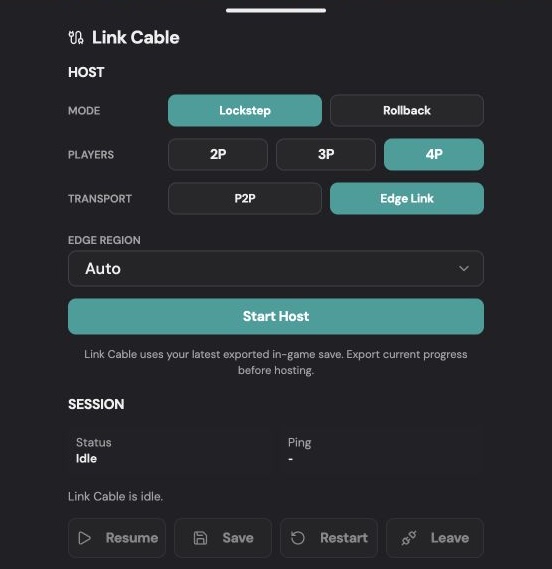
For Rebit, the Link Cable manual describes linking compatible handheld games from separate devices. The room connection does not replace the game's own battle rules or compatibility requirements. Use your own legally obtained game files; Rebit does not provide copyrighted ROM downloads.
Agree on a disconnect procedure too. A practical proposal is to record the interruption, allow a specified number of restarts with the same teams, then refer repeated failures or disputes to the organizer. Host or guest status alone does not establish who caused a connection failure. Our netplay freeze reporting guide explains which technical details help support investigate; a technical report and a tournament ruling serve different purposes.
Record results once, with both players confirming
Use a match log alongside the standings. Players can submit this in the tournament thread:
Round:
Player A vs Player B:
Winner, or pending:
Opponent confirmation:
Issue requiring organizer review, if any:
Let one organizer update the official table from confirmed reports. Keep corrections visible in the match log. A second public bracket can be useful for spectators, but say which record wins if the two disagree.
Before announcing the finalists, check that all 10 group matches have a confirmed result or an explicit ruling, each player has four recorded opponents, and the published tie procedure has been applied. Under the proposed decisive-match scoring, the group stage awards 10 wins in total; byes must not inflate that number.
To put the plan into practice, replace A–E with five confirmed players, share the schedule and rules, and arrange one short connection test per pairing. That turns an invitation to play retro games online with friends into an event people can actually prepare for.