Ask most people about early PlayStation and they’ll say Resident Evil, Final Fantasy VII, Metal Gear Solid, maybe Tekken 3. Fair.
But if you’re a run-and-gun nerd, there’s a different answer that deserves way more love: Rapid Reload (aka Gunners Heaven).
This game is what happens when a dev team understands momentum, screen readability, and boss rhythm on a serious level. It came out in 1995, got buried in the “everything must be 3D” era, skipped North America, and quietly became one of the best hidden gems on PS1.
If you like fast retro action games, this one is not optional.
What is Rapid Reload?
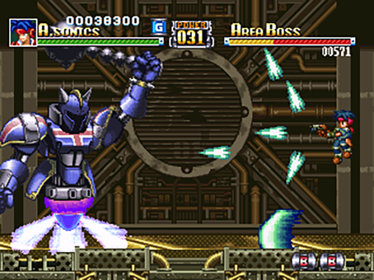
Rapid Reload is a 2D run-and-gun game developed by Media.Vision (yes, the studio behind Wild Arms), released on PlayStation in 1995.
At first glance, you can instantly see the Gunstar Heroes influence. Big attacks, aggressive pace, flashy bosses, constant movement pressure. But this is not a cheap clone. It has its own combat feel, own movement rhythm, and own identity.
And honestly? It still slaps.
Why was Rapid Reload forgotten?
Three big reasons:
- No North American release — It launched in Japan and Europe, so it missed a massive audience.
- Wrong market timing — 1995–1997 gaming culture was obsessed with 3D branding.
- No co-op mode — In a genre where couch co-op often drives legend status, that hurt word-of-mouth.
So yeah, the game didn’t fail because it lacked quality. It got out-marketed by a trend cycle.
What makes Rapid Reload special (real nerd breakdown)
Let’s get into the good stuff.
1) The game teaches aggression, not passive survival
A lot of action games let you turtle and inch forward. Rapid Reload nudges you the opposite direction.
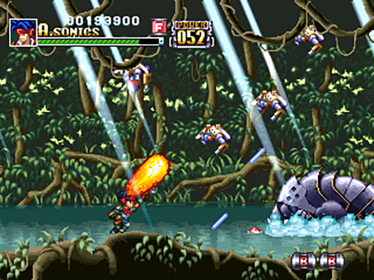
The power-up flow and enemy pressure reward you for staying active, controlling the screen, and converting openings fast. You feel stronger when you play with intent, not when you hide.
That creates a super satisfying skill curve: the better you get, the faster and cleaner your runs look.
2) Character choice changes route logic
You pick between Axel and Ruka, and this actually matters. Weapon behavior and practical use cases shift how you approach segments.
That means replayability is not fake replayability. Your decisions change:
- How you manage crowded lanes
- Which enemies you prioritize first
- When to commit to close-range pressure vs safer distance
For speedrun-minded players, this opens different route personality right away.
3) Weapon feel is crisp and readable under pressure
This is where many retro action games age badly. Inputs feel mushy, hit feedback gets noisy, and visual clutter kills clarity.
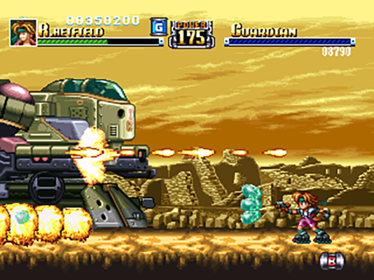
Rapid Reload avoids that. Even in chaos, you can parse threat lines, weapon coverage, and movement gaps quickly.
When a game lets you read the battlefield this clearly, it stays fun for decades.
4) Boss design hits the sweet spot: scary but learnable
Great run-and-gun bosses should feel overwhelming at first, then readable on repeat.
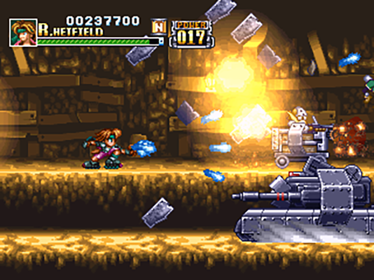
Rapid Reload nails this. Bosses have personality and spectacle, but their patterns are still structured enough for mastery. You’re not gambling. You’re learning.
That “death -> adaptation -> clean clear” loop is exactly what keeps high-tempo games alive long-term.
5) 2D animation and pacing aged better than many early 3D games
Hard truth: tons of mid-90s 3D games aged rough visually and mechanically.
Meanwhile Rapid Reload still looks and plays sharp because it focused on fundamentals:
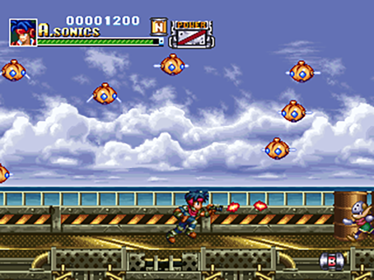
- Clear silhouettes
- Strong attack readability
- Fast transitions into combat states
- Confident frame-to-frame animation
This is why “2D done right” often outlives “new tech done early.”
6) It’s a great case study in “genre memory gaps”
If you map run-and-gun history and skip Rapid Reload, the timeline feels incomplete.
It sits in that important bridge zone:
- Post-16-bit design thinking
- Early PlayStation hardware context
- Still deeply arcade-minded in flow
For retro game history fans, it’s not just a recommendation. It’s required reading.
Rapid Reload vs Gunstar Heroes: clone or cousin?
The lazy take is “PS1 Gunstar clone.” The better take is “same bloodline, different personality.”
Where they overlap:
- Hyperactive run-and-gun structure
- Weapon experimentation
- Showpiece boss fights
Where Rapid Reload diverges:
- Slightly different movement/combat cadence
- Distinct pacing in stage flow
- Different risk-reward texture in moment-to-moment play
If you love Gunstar Heroes, this is exactly the kind of “parallel evolution” game you should check.
What most players still miss
People judge this game from screenshots or 30-second clips. That misses the point.
Rapid Reload is a motion-first game. Its value is in how systems interact while you’re under pressure:
- How quickly you can recover after a mistake
- How weapon selection changes lane control
- How bosses force repositioning discipline
- How tempo stays high without turning unreadable
In short: watch it for style, play it for depth.
Is Rapid Reload still worth playing in 2026?
Absolutely.
If you’re into:
- Retro action games with real execution depth
- Fast boss-learning loops
- Tight run-and-gun pacing
- Underappreciated PlayStation classics
…then this game is still extremely worth your time.
How to enjoy this game style on Rebit
Even though Rapid Reload itself is single-player, Rebit is still the best way to turn this kind of retro action into a social hobby.
Here’s how we recommend using it:
- Challenge nights: compare stage clear times with friends
- Segment practice: share save states and grind hard boss sections
- Rule-based runs: no-damage, weapon-limited, or speed checkpoints
- Genre sessions: jump from Rapid Reload to Contra to Metal Slug without setup pain
If your goal is to play retro games online with your crew and keep the friction low, Rebit is built for exactly this workflow.
Sign in to Rebit, then tune your sessions with the multiplayer netplay documentation. For more PlayStation setup context, start with play PS1 games online.
Rebit does not provide PS1 disc images or copyrighted ROM downloads. Bring legally owned game files, then use save states, screenshots, and browser sessions to study this kind of run-and-gun design without setup drag.
What to play next if Rapid Reload clicks with you
If this game hits your brain in the right way, go straight to:
- Gunstar Heroes — the core lineage benchmark
- Contra III — precision chaos done perfectly
- Metal Slug — animation craftsmanship + combat readability
- Alien Soldier — boss gauntlet intensity and system depth
This gives you a killer mini-curriculum in run-and-gun design evolution.
Final verdict
Rapid Reload is one of those games that proves a painful truth: quality and visibility are not the same thing.
It got overshadowed by market timing, region strategy, and genre trends—not by weak design. Under the hood, it’s still a viciously fun, smartly tuned action game with real mastery potential.
If you’re a retro gamer, a run-and-gun fan, or just someone who loves discovering lost classics, play it.
Not because it’s “underrated.”
Because it’s genuinely good.