Complete History of Contra: Why Konami's Run-and-Gun Classic Still Matters
Few retro action series explain the appeal of arcade design better than Contra. It is fast, loud, unfair-looking until you understand it, and built around one of the purest promises in video games: two commandos, impossible odds, one-hit deaths, and just enough control precision to make every victory feel earned.
This detailed history follows Contra from Konami's arcade golden age through the NES phenomenon, the 16-bit high points, the painful 3D years, the handheld and digital revivals, and the modern return of Contra: Operation Galuga. It also explains why Contra is still useful for modern retro players: the series is a perfect case study in what makes side-scrolling action work, why co-op matters, and why preservation-friendly browser play is becoming more important for classic games.
If you want to play retro games online with your own legally owned game files, Rebit gives you a browser library for supported systems, save management, and private play flows without sending you into emulator-folder chaos. Contra's history is exactly the kind of history worth preserving and replaying carefully.
Quick answer
- Contra began in Japanese arcades in 1987 as Konami's explosive answer to military action films, alien sci-fi, and stiff early shooter formats.
- The 1988 NES version became the defining Contra for many players, partly because it reworked the arcade design into a longer, memorization-heavy home experience.
- The Konami Code became permanently tied to Contra because the NES game was brutally difficult and the 30-life code made it approachable.
- Contra 3: The Alien Wars and Contra: Hard Corps are the 16-bit peaks, pushing the formula into cinematic SNES spectacle and aggressive Genesis experimentation.
- The PlayStation-era 3D attempts damaged the series because they lost the precision platforming, immediate aiming, and readable screen design that made Contra feel fair.
- Modern revivals work best when they respect the 2D core, which is why Contra 4, Contra Rebirth, Hard Corps: Uprising, and Operation Galuga are more interesting than generic reinventions.
- For Rebit players, Contra is a reminder to protect saves, practice patterns, and use co-op-friendly workflows when revisiting demanding retro action games with your own legally owned files.
Why Contra mattered before Contra existed
In the mid-1980s, Konami was one of the most dangerous studios in the arcade. The company had range. Gradius showed how elegant a scrolling shooter could be. Track & Field turned button mashing into a competitive sport. Metal Gear was beginning to explore stealth on home hardware. Konami understood rhythm, pressure, and hardware limits in a way few publishers could match.
But shooting games still had a gap.
Arcades had fixed-screen shooters, where you moved in a limited space while enemies descended. They had vertical or horizontal scrolling spaceship shooters, which offered speed and spectacle but often kept players detached from the action as tiny ships. They had ground-based military shooters like Commando and Ikari Warriors, which put a soldier on the screen but often felt slower, stiffer, or less acrobatic than players wanted.
What Contra did was combine three fantasies:
- Ground combat — you were not a spaceship; you were a commando on the ground.
- Platforming precision — you jumped, ducked, climbed, and threaded shots through hazards.
- Arcade shooter intensity — enemies arrived constantly, and one mistake could end a life.
That combination matched the culture of the moment. The 1980s were full of muscular action cinema: jungle commandos, alien threats, impossible rescue missions, explosive finales, and heroes who survived because they kept moving. Contra translated that feeling into controls.
1987: Contra hits the arcade
Contra arrived in Japanese arcades in February 1987. The timing gave the name extra edge because the Iran-Contra affair was still in international headlines. Konami never clearly confirmed that the game was named after the Nicaraguan Contra rebels, but the original arcade ending theme being titled "Sandinista" made the connection hard to ignore.
The politics mattered less to players than the first thirty seconds of gameplay.
Two commandos, Bill Rizer and Lance Bean, drop into an alien-infested battlefield. The visual language is pure 1980s military sci-fi: shirtless commandos, jungle combat, biomechanical aliens, and boss designs that feel like they escaped from a movie-night collision of Predator and Aliens.
Contra's arcade cabinet also made unusual technical choices. It used a vertical screen orientation, normally associated with space shooters. For a side-scrolling run-and-gun game, that sounds strange. But it helped the pseudo-3D base stages feel more imposing and gave the larger alien bosses a sense of height and scale. When the final alien presence filled the screen, it felt enormous.
What really made Contra special, though, was control.
You could:
- run and stop instantly,
- jump with clear arcs,
- fire in eight directions,
- shoot diagonally while moving,
- dodge through dense enemy patterns,
- and trust that most deaths were harsh but understandable.
That trust is the foundation of Contra. The series is brutal, but the best entries rarely feel random. They punish hesitation, greed, and bad positioning, not vague controls.
The weapon system: simple, readable, brilliant
Contra's weapons became iconic because they were easy to understand under pressure.
The spread gun became the legend: a fan of bullets that covered huge space and turned screen management into controlled aggression. The machine gun helped players hold fire. The laser rewarded accuracy but could feel risky. The fireball or rotating projectile had situational value. Power-ups were not just stronger numbers; they changed how players read the screen.
The most important design trick is that losing a weapon hurts. Contra is a one-hit-death game, so dying does not just cost a life. It can reset your momentum. A player who dies with the spread gun often respawns with weaker firepower and must rebuild control over the stage. That creates tension without complicated systems.
This is why Contra is still useful to study. Modern games often add layers of upgrades, menus, currencies, and builds. Contra proves that a small set of sharply differentiated tools can create just as much drama.
Co-op made Contra more than a hard shooter
Two-player simultaneous action existed before Contra, but Contra made co-op feel like a shared panic attack in the best possible way.
Co-op adds problems and comedy:
- Who gets the spread gun?
- Who scrolls the screen forward too early?
- Who dies and respawns with the default rifle?
- Who panics during a boss and jumps into the one bullet everyone else saw coming?
Contra's co-op is not just two players doing the same thing. It changes pacing. One player can cover diagonals while the other clears ground enemies. One player can take risks for power-ups. One player can drag the other into danger by advancing the screen. The game becomes communication under fire.
That is why Contra remains relevant for Rebit's world of private retro rooms and browser play. Some retro games are solitary score chases; Contra is a social test. If you want to play retro games online with friends, run-and-gun games show why low-friction co-op matters.
1988: The NES version becomes the Contra most people remember
The arcade version started the legend, but the NES version made Contra a household name.
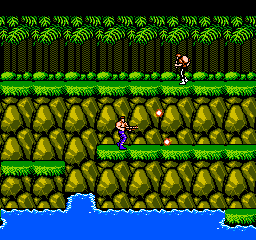
Released in 1988, the NES port was not a simple downgrade. It was more like a redesign. The arcade game had to feed quarters and deliver constant pressure. The NES version had to survive living-room repetition. It expanded stages, changed pacing, and leaned harder into memorization.
The NES hardware could not fully reproduce the arcade presentation, but it gave players something else: a version they could practice for weeks. The stage layouts became burned into memory. The jungle, base corridors, waterfall, snowfield, energy zone, hangar, and alien lair became a rite of passage.
For many players, Contra on NES became the definitive Contra because it struck the perfect balance between accessibility and cruelty:
- The controls were immediate.
- The stages were readable.
- The weapons were exciting.
- The difficulty was high but learnable.
- The soundtrack had that unmistakable Konami energy.
It was also one of those games people bought an NES for. That matters. Some games are good library additions; Contra felt like a system justification.
The Konami Code and the 30-life myth
The famous input — Up, Up, Down, Down, Left, Right, Left, Right, B, A, Start — did not begin with Contra, but Contra made it immortal.
Originally used in Gradius as a testing shortcut, the code gave players 30 lives in Contra. It did not make the game easy, exactly. It made the game survivable enough for kids, siblings, and friends to see more than the first few stages.
That is why the code became pop culture. It was not just a cheat; it was an access bridge. It let more people experience the full shape of a demanding game.
There is a lesson here for modern retro players. Difficulty options, save states, rewind, and browser save tools can be controversial, but they often serve the same role: they let people study and enjoy games that were originally built for different time, hardware, and arcade-economy expectations.
On Rebit, the key is to use those tools honestly. Save states are great for practice, but if you care about a clean clear, preserve a separate run and treat practice states as training wheels.
Regional versions: Famicom extras and Probotector robots
Contra's regional history is also part of its identity.
Japanese Famicom players received a more advanced version using Konami's VRC2 chip, which allowed extra animations and story sequences that were not present in the North American NES release. Those extras gave the Japanese version a slightly richer presentation.
Europe had a stranger transformation. Due to censorship concerns, especially in Germany, Contra was reworked as Probotector. Human soldiers and enemies became robots. The gameplay remained mostly intact, but the tone changed. For many European players, robots were Contra. That alternate identity lasted for years and became a fascinating preservation branch of the franchise.
This is one reason historical context matters. The "same" retro game may have different names, sprites, cutscenes, or censorship edits depending on region. If you bring your own legally owned game files into a modern library, keep track of region and version because they can affect saves, patches, expectations, and nostalgia.
Super Contra and Super C: bigger, louder, harder
Konami moved quickly. Super Contra arrived in arcades just one year later, replacing the pseudo-3D base corridors with top-down vertical sections. The sequel pushed intensity: more enemies, bigger explosions, stronger animation, and a greater sense that the screen was always about to collapse under pressure.
The NES adaptation, Super C, arrived in 1990. It lacked some arcade features, but it added new stages and became another strong home entry. It did not have the same mythic cultural weight as the original NES Contra, but it refined the formula and helped establish the genre language that later games like Gunstar Heroes and Metal Slug would push even further.
Super C is important because it shows Contra becoming a template. Once a game influences everything after it, it can start to feel "standard" to modern players. That is not a weakness. It means the game helped define the standard.
Operation C on Game Boy: Contra without co-op
The Game Boy entry, Operation C, proved that Contra could survive on weaker hardware. It compressed the formula into portable form and introduced the homing gun to the franchise.
But it had one major absence: no multiplayer.
That limitation mattered because Contra is not only about shooting aliens. It is about shared chaos. Operation C is impressive as a portable adaptation, but the missing co-op reminds us that technical achievement and social feeling are not the same thing.
For modern retro play, that distinction still matters. A game can run, but does it preserve the reason people loved it? Does it support the control feel, save flow, display clarity, and multiplayer rhythm that made the original memorable?
Contra Force: the name without the soul
Contra Force is one of the strangest entries in the series. Released for NES in 1992, it had interesting ideas: selectable characters, different weapon configurations, and a power-up system reminiscent of Gradius.
But it was not originally designed as a Contra game. It began as an unrelated project called Arc Hound. After its Japanese release was canceled, it was repurposed for North America with the Contra name attached.
That decision shows immediately. Contra Force lacks the alien invasion identity, futuristic military-sci-fi tone, and clean speed of the main series. It also suffers from severe slowdown and flicker. A few good ideas cannot overcome a mismatch between brand and design.
This is the first major warning in Contra's history: a famous name does not guarantee the right feel.
Contra 3: The Alien Wars — the 16-bit peak
Then came redemption.
Contra 3: The Alien Wars launched on Super Nintendo in 1992 and remains one of the greatest action games on the platform. It understood what Contra needed to become in the 16-bit era: bigger, more cinematic, but still precise.
Contra 3 added:
- two held weapons that players could switch between,
- screen-shaking explosions,
- enormous bosses,
- Mode 7 top-down stages,
- a motorcycle chase,
- mid-air missile riding,
- and a pace that rarely lets the player breathe.
It is easy to describe Contra 3 as spectacle, but the real achievement is that it remains playable spectacle. The screen is busy, yet readable. The set pieces are wild, yet built around inputs the player can trust. The bosses are huge, but not just decorative.
If someone wants to understand Contra in one game, Contra 3 is probably the best recommendation. The NES original is historically essential, but Contra 3 shows the formula at full theatrical power.
For Rebit readers, Contra 3 is also a good reminder to protect progress in difficult games. Whether you are practicing with save states or playing straight, create deliberate checkpoints and understand the difference between practice tools and a real clear. Rebit's guide to save states vs in-game saves is useful context for that.
Contra: Hard Corps — the Genesis goes feral
In 1994, Contra: Hard Corps brought the series to Sega Genesis and pushed it in a more experimental direction.
Hard Corps introduced:
- four playable characters,
- unique weapon sets,
- branching paths,
- multiple endings,
- faster pacing,
- and a more anime-influenced presentation.
It is one of the most aggressive games in the series. It throws bosses at the player with almost reckless confidence. It expects repetition, pattern learning, and quick reactions. It also offers more replay value than many earlier Contra games because character choice and route selection change the experience.
Hard Corps can feel divisive because it is not simply "more Contra 3." It is stranger and sharper. But that is why it has aged well. It treats Contra as a flexible language instead of a fixed checklist.
The PlayStation-era 3D problem
By the mid-1990s, every major franchise faced the same question: how do we survive 3D?
Mario solved it. Zelda solved it. Metal Gear would soon solve it. Contra did not.
Contra: Legacy of War arrived in 1996 and moved the series into an isometric 3D perspective. The problem was not simply that it was different. The problem was that it lost Contra's core strengths:
- precise platforming,
- clean directional shooting,
- readable enemy patterns,
- fast restarts,
- and co-op immediacy.
Movement felt clunky. The camera fought the player. The action lacked the snap that made older Contra deaths feel fair. The included anaglyph 3D glasses could not hide the design problem.
C: The Contra Adventure tried again in 1998 by mixing 2D and 3D sections. Some side-scrolling moments hinted at a better game, but the package still felt compromised. Worse, it lacked multiplayer, which made it feel even less like Contra.
This period explains an important preservation lesson: the look of a franchise matters less than its interaction model. Contra is not Contra because a soldier shoots aliens. Contra is Contra because movement, aiming, enemy pressure, and co-op tension form a very specific rhythm.
Shattered Soldier: back to 2D, but colder
In 2002, Contra: Shattered Soldier on PlayStation 2 returned the series to 2D action. That alone was a major correction.
But it also changed the formula. Instead of picking up weapons during stages, players had a fixed set of weapons available from the start. The game leaned into performance ranking and locked its true ending behind strong stage results.
Shattered Soldier has excellent boss design and real intensity. It understands that Contra works better as precise 2D action than as clumsy 3D experimentation. But it also feels colder and more rigid than the 8-bit and 16-bit classics. The fixed weapon system removes some of the desperation that comes from losing your favorite upgrade mid-stage.
It is a strong game, but not the easiest recommendation for someone looking for the pulpy joy of Contra 3.
Neo Contra: weird, confident, and better than expected
Neo Contra followed in 2004 and moved back toward an isometric perspective, but with much stronger execution than the PlayStation entries.
It is not a classic side-scroller. It is more of a high-skill action reinterpretation. Players select weapon configurations before missions, chase scores, and survive ridiculous set pieces. Running across helicopter blades while shooting down missiles is exactly the kind of nonsense Contra can support when the controls are sharp enough.
Neo Contra is valuable because it proves experimentation is not the enemy. Bad execution is the enemy. Contra can change camera, structure, or scoring emphasis if it preserves responsiveness, readable danger, and over-the-top momentum.
Contra 4: WayForward understands the assignment
In 2007, Contra 4 arrived on Nintendo DS from WayForward. It was not developed internally by Konami, but it understood classic Contra better than several internal or licensed attempts.
Contra 4 used the DS dual screens for taller stages, added a grappling hook, brought back traditional weapon pickups, and modeled itself heavily on Contra 3. The result was a hard, affectionate sequel that treated Contra's history as a toolbox.
It also revived the pseudo-3D tunnel idea from the arcade original and included unlockables and challenge modes. The difficulty was fierce, but that is part of the point. Contra 4 did not apologize for being Contra.
WayForward's work matters because it shows how a modern studio can respect an old series without merely copying it. The best revivals identify the core loop, then add features that strengthen it instead of replacing it.
Contra Rebirth and the danger of digital disappearance
Contra Rebirth arrived on WiiWare in 2009, developed by M2. It delivered a polished 2D side-scrolling Contra experience with sprite-based visuals, unlockable characters, and a clear love for the classic formula.
The tragedy is availability.
Because Contra Rebirth was a digital WiiWare release, it became impossible to buy legally after the Wii Shop Channel closed in 2019. Players who did not purchase it during its availability window lost the normal legal path to access it.
That is a preservation problem. Retro game history is not only about cartridges and discs. Digital-only games can disappear faster than physical media. Contra Rebirth is one of the better modern Contra games, yet it now exists in a legal access gap.
For modern players, this is why personal libraries, save exports, and preservation-minded platforms matter. Rebit does not provide copyrighted games or ROM downloads. But for your own legally owned files on supported systems, a browser library can make play sessions and save continuity less fragile than scattered local setups.
Hard Corps: Uprising — Contra in anime armor
In 2011, Arc System Works released Hard Corps: Uprising for Xbox Live Arcade and PlayStation Network. It dropped the Contra name in the title, but the DNA was obvious: side-scrolling action, punishing difficulty, co-op, and huge bosses.
As a prequel to Hard Corps, it leaned into anime presentation and fighting-game-style flair. That could have gone badly, but Arc System Works brought mechanical precision. Uprising feels like a radical reinterpretation rather than a careless reskin.
It also shares the digital-access concern. It is more available than WiiWare Contra Rebirth, but it still belongs to the era of platform storefront dependence. If a game matters to you, do not assume access will remain simple forever.
The quiet years: mobile, pachinko, and brand drift
From the late 2000s into the 2010s, Konami's priorities shifted. Contra appeared in mobile releases and pachinko or slot-machine adaptations while major console entries slowed down.
This period frustrated fans because Contra had always represented direct action. Seeing the brand drift into formats far removed from the original appeal made the series feel neglected.
Legacy brands often enter this stage. A company knows the name has value but no longer knows what experience the name should deliver. Contra's next major console return would prove the risk.
Rogue Corps: what not to do with a legacy name
Contra: Rogue Corps launched in 2019 and was marketed as a console comeback. Instead, it became another example of brand mismatch.
The game moved into a top-down twin-stick structure, but the shooting lacked the crispness fans expected. The visuals were muddy, missions felt repetitive, and the new cast did not carry the same immediate appeal as Bill, Lance, or the series' classic alien-war identity.
The issue was not that Contra can never be top-down. Super Contra and Neo Contra already proved the series can shift perspective. The issue was that Rogue Corps did not feel precise, iconic, or essential. It felt like a generic product wearing a famous logo.
That is the central danger for retro revivals: nostalgia can get people to look, but only feel can make them stay.
The Contra Anniversary Collection helped restore context
Konami's Contra Anniversary Collection helped repair some of the damage by gathering many classic entries in one place. It included arcade Contra, Super Contra, NES Contra, Super C, Operation C, Contra 3, Hard Corps, and regional variants.
Collections like this are important because they let players understand a series as a timeline rather than isolated memories. You can see how the arcade version differs from the NES version. You can see how Contra 3 expands the formula. You can compare Hard Corps' branching aggression with Super Nintendo spectacle.
For Rebit readers, this is also a good way to think about your own retro library. Organize games not only by system, but by relationships: arcade original, home port, sequel, regional version, remake, spiritual successor. A browser library becomes more useful when it helps you remember why each file matters.
Operation Galuga: WayForward returns again
In 2024, WayForward returned with Contra: Operation Galuga, a reimagining of the 1987 original.
This was the right studio for the job. WayForward had already proven with Contra 4 that it understood the formula. Operation Galuga brings back Bill Rizer and Lance Bean, rebuilds classic stages with modern production values, and keeps the cooperative chaos central.
The strongest thing about Operation Galuga is that it does not confuse modernization with replacement. It updates movement, presentation, bosses, and set pieces while preserving the Contra essentials:
- sharp movement,
- readable enemy pressure,
- memorable bosses,
- co-op tension,
- and the feeling that one good run can survive impossible odds.
The main caveat is performance. The Nintendo Switch version has been criticized for frame rate drops and visual compromises. That matters more in Contra than in many genres because timing is everything. A run-and-gun game lives or dies on input trust.
Operation Galuga's lesson is clear: Contra can still work today, but only if the action remains smooth and responsive.
The Contra timeline at a glance
| Year | Game | Platform/context | Why it matters |
|---|---|---|---|
| 1987 | Contra | Arcade | Defines the run-and-gun identity: eight-way shooting, co-op, alien war, tight control |
| 1988 | Contra | NES/Famicom | Becomes the household classic and popularizes the Konami Code connection |
| 1988/1990 | Super Contra / Super C | Arcade/NES | Pushes intensity and helps define the side-scrolling shooter template |
| 1991 | Operation C | Game Boy | Strong portable adaptation, but loses co-op |
| 1992 | Contra Force | NES | Repurposed project that shows the danger of attaching the name without the feel |
| 1992 | Contra 3: The Alien Wars | SNES | One of the series' high points; cinematic 16-bit action with excellent control |
| 1994 | Contra: Hard Corps | Genesis | Branching, character-driven, brutally fast, and highly replayable |
| 1996 | Contra: Legacy of War | PlayStation/Saturn | 3D transition loses precision and damages the brand |
| 1998 | C: The Contra Adventure | PlayStation | Partial correction but still compromised and missing co-op |
| 2002 | Contra: Shattered Soldier | PlayStation 2 | Returns to 2D with a stricter, ranking-focused structure |
| 2004 | Neo Contra | PlayStation 2 | Weird but competent isometric reinvention |
| 2007 | Contra 4 | Nintendo DS | WayForward's excellent classic revival |
| 2009 | Contra Rebirth | WiiWare | Strong digital-only revival now trapped by storefront closure |
| 2011 | Hard Corps: Uprising | XBLA/PSN | Arc System Works reinvents the formula with anime style and precision |
| 2019 | Contra: Rogue Corps | Modern platforms | Misfires as a generic top-down revival |
| 2024 | Contra: Operation Galuga | Modern platforms | Reimagines the original with modern production and classic priorities |
What made the best Contra games work?
Across the series, the best Contra games share a few traits.
1. Immediate control trust
When the player presses jump, aims diagonally, or changes direction, the game must respond instantly. Contra's difficulty only works if the player believes the controls are honest.
2. Readable chaos
The screen can be busy, but threats must be understandable. Contra 3 can look insane, yet strong players can read it. Bad Contra entries look messy without giving the player enough information.
3. Co-op pressure
Contra is better when another player is there to save the moment or ruin it. Good co-op creates stories. The spread gun argument is part of the design.
4. Weapon drama
Power-ups should change behavior, not just increase damage. Losing a weapon should hurt because it changes how you approach the screen.
5. Short loops and pattern learning
Contra is not about grinding stats. It is about trying, dying, learning, and returning sharper. That is why save-state practice can be useful, but the real satisfaction comes from mastering patterns.
How to revisit Contra-style games today
If you are returning to Contra or exploring run-and-gun games for the first time, use a practical approach.
Start with the essentials
Begin with one of these:
- Contra (NES) if you want the cultural classic.
- Contra 3: The Alien Wars if you want the best single recommendation.
- Contra: Hard Corps if you want branching replayability and Genesis intensity.
- Contra 4 if you want a demanding modern classic-style sequel.
- Operation Galuga if you want a modern reimagining.
Treat save states as practice, not proof
Use save states to learn boss patterns, weapon routes, and stage hazards. But if you care about a full clear, do separate runs without relying on mid-stage rewinds. Practice tools are most satisfying when they help you eventually play cleaner.
Play co-op when possible
Contra's best moments often happen when two players barely survive together. If you want the social side of retro action, use a setup that makes private play simple. Rebit's play retro games online with friends page is the right starting point for that kind of session.
Keep your own legally owned files organized
Rebit does not provide ROM downloads or copyrighted game sources. Bring your own legally owned game files, keep backups, and use clear save management. If you upload supported files to Rebit, you can use a browser flow instead of constantly managing emulator folders. Start with upload ROM and play online and the broader guide to play retro games online.
Why Contra still belongs in a browser-era retro library
Contra's design is old, but its needs are modern:
- fast access,
- reliable controls,
- clear save practice,
- private co-op sessions,
- and a way to return without reinstalling an emulator stack every time.
That is why Contra-style games fit naturally into a browser retro workflow when the system supports them. A game built around repeated attempts benefits from quick launch. A co-op game benefits from easy room setup. A difficult game benefits from visible save tools. A historically important series benefits from a library that makes context and replay easier.
Rebit is built around that idea: supported retro games in the browser, with your own legally owned files, save tools, screenshots, and ways to play with friends. The point is not to replace every emulator or every original console. It is to make the next session easier to start and safer to continue.
FAQ
What is the best Contra game to start with?
For most new players, Contra 3: The Alien Wars is the best starting point because it captures the series' speed, spectacle, co-op pressure, and boss design at a high level. The NES Contra is historically essential, but Contra 3 often feels more immediately exciting to modern players.
Is the NES Contra still worth playing?
Yes. The NES version remains one of the cleanest examples of learnable difficulty in 8-bit action games. It is strict, but the controls, weapon system, and stage structure still hold up.
Why is the Konami Code associated with Contra?
The code existed before Contra, but Contra made it famous because the 30-life version helped players survive a very difficult game and see more of the experience. It became part of the social memory of playing Contra on NES.
Which Contra games are weakest?
The PlayStation-era Contra: Legacy of War and C: The Contra Adventure are usually considered low points because they struggled with 3D movement, camera clarity, and the loss of classic precision. Contra: Rogue Corps is also widely criticized for feeling generic and imprecise.
Is Contra better alone or in co-op?
Both work, but co-op is central to the series' identity. Solo play is cleaner and more controlled. Co-op is messier, funnier, and often more memorable.
Can I play Contra-style retro games on Rebit?
Rebit supports browser play for user-owned game files on supported systems. It does not provide copyrighted ROMs or download sources. If you have your own legally owned files, Rebit can help organize browser play, saves, and private sessions depending on the system and game compatibility.
Why do some Contra games feel wrong even when they include shooting and aliens?
Because Contra is not just a theme. It depends on immediate controls, readable danger, co-op pressure, and short pattern-learning loops. If those are missing, the game may have the Contra name without the Contra feel.
Final recommendation
Contra's history is a cycle of brilliance, mistakes, recovery, and reinvention. The original arcade game found the formula. The NES version made it legendary. Contra 3 and Hard Corps stretched it into two different 16-bit peaks. The early 3D entries showed how easily the feel could be lost. Later revivals proved the series could still work when developers respected the core.
If you want to understand run-and-gun design, study Contra. If you want to enjoy it, play with a friend, protect your progress, and treat every death as information. And if you are building a modern retro library, keep Contra's lesson in mind: classic games survive best when the path back to playing them is simple, legal, and faithful to the feel that made them matter.
Start with your own legally owned files, keep your saves safe, and use Rebit's browser workflow when you want less setup between you and the next run.