The source video opens with a point that still feels true in 2026: the Nintendo DS was not just another portable revision cycle. It was a strange machine that forced designers to make hard interface decisions every minute. Two screens. Stylus input. Small physical footprint. Limited horsepower. In other words, exactly the kind of constraints that produce creative game design instead of safe game design.
Its 10-game lineup is a useful cross-section of that design era: licensed platformers that overperform, tactical remakes that become onboarding tools, late-generation action games that refuse to die quietly, and RPG systems that treat timeline management as core interaction instead of lore decoration.
Why This List Works as a Design Study (Not Just a Nostalgia List)
The video does not frame these picks as museum pieces. It keeps circling the same design question: how do you make 2D games feel fresh on a device where one extra button press already feels expensive?
Three repeated answers show up across the list:
- Split responsibility across screens.
- Use touch where it shortens friction, not where it looks flashy.
- Keep game feel brutally responsive, because small handheld sessions expose sloppy controls immediately.
That pattern is why the list hangs together even when the genres jump from Kirby to Fire Emblem to Contra to Radiant Historia.
Batman: The Brave and the Bold Shows How to Salvage a Licensed Game
One of the video's strongest calls is Batman: The Brave and the Bold on DS. Instead of chasing maximal combat spectacle, this version leans into clean 2D platforming plus a partner-swap system through touch input. That single decision does two things at once: it gives mission-to-mission mechanical variety, and it makes the DS form factor part of the strategy loop rather than an afterthought.
The host highlights a detail that matters more than people admit: difficulty comes from learning character utility, not wrestling with bad controls. On a handheld, that distinction is everything. If jumps feel mushy for even ten minutes, players bounce.
WayForward's sprite work is also called out, and rightly so. The game uses readable silhouettes and crisp animation timing that survive the DS's small display better than many louder, blurrier contemporaries.
Kirby Squeak Squad and Castlevania: Dawn of Sorrow Show Two Opposite Touch Philosophies
The video puts these games near each other, and that comparison is gold.
In Kirby Squeak Squad, the second screen acts as a utility layer for item storage and ability management. It is practical, slightly limited, but usually friction-reducing.
In Castlevania: Dawn of Sorrow, map visibility and touchscreen support help exploration, but the magic seal boss finisher can interrupt combat flow. The host's criticism lands: when input novelty arrives at exactly the wrong emotional moment, it feels like hardware tax instead of design value.
That contrast is a handheld design lesson in one sentence: touch mechanics are strongest when they compress cognitive overhead, weakest when they hijack pacing.
Monster Tale Is the Most "Only on DS" Pick in the Whole Video
This is where the source video gets really interesting. Monster Tale (from the team behind the commercial failure of Henry Hatsworth) combines a top-screen action-platformer with bottom-screen companion management for Chomp in real time. The host describes it as platformer-meets-Tamagotchi, and that is exactly the flavor.
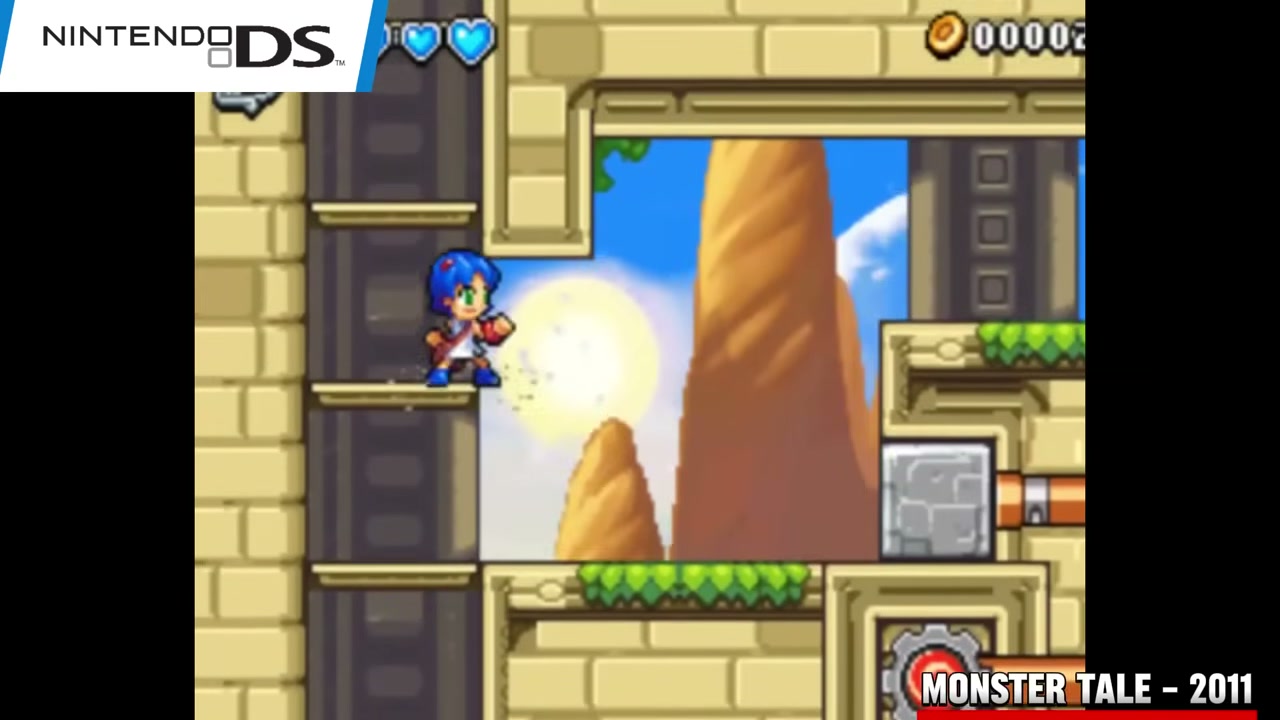
The important part is not the novelty. It is the interaction bandwidth. While Ellie navigates combat and traversal, Chomp's evolution and state feed back into encounter options. That creates a loop where interface context is always active, and the player is never just "waiting for the next room." Even with backtracking and a more guided map flow, that two-channel interaction gives the game real identity.
Fire Emblem: Shadow Dragon and Dragon Quest IV Use the DS to Modernize Classics Without Breaking Them
The video's coverage of Fire Emblem: Shadow Dragon makes a practical point that remake teams still struggle with: modernization is not only visual. It is also about lowering control friction and information friction.
Stylus input is optional, not mandatory. Tactical depth stays intact. Presentation is cleaner. Players who came from Advance Wars can map their habits quickly. This is textbook adaptation work.
Then Dragon Quest IV appears as another type of modernization: structure-first storytelling where chapter-based character arcs eventually converge. The host emphasizes that this framing makes the final chapter hit harder because prior segments stop feeling disconnected once the cast consolidates.
That chapter choreography is old-school craft, but on DS it becomes more digestible through portable pacing: short sessions, clear progress, strong contextual memory between play bursts.
Contra 4 and Aliens: Infestation Prove Late-Era DS Still Had Teeth
Around the 10 to 13 minute stretch, the video pivots to late-cycle intensity and nails the tone.
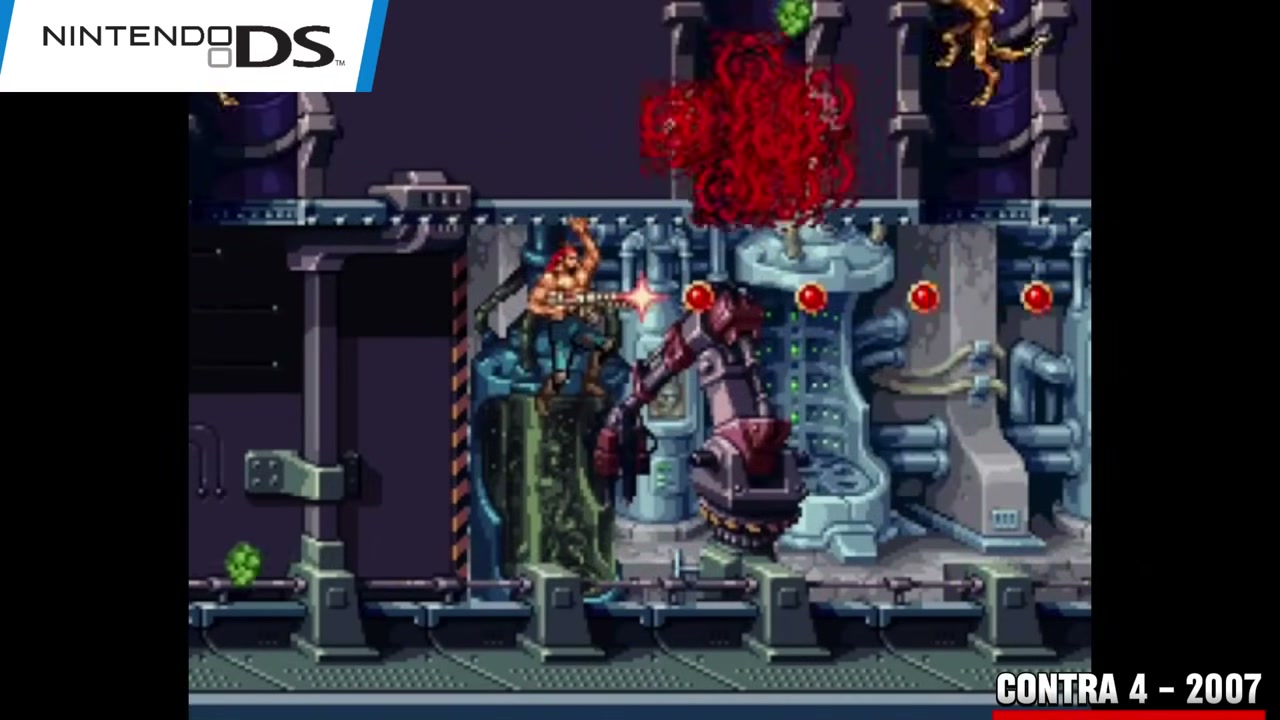
Contra 4 is presented as a return-to-2D correction after 3D detours. The reasons are concrete: grapple mobility adds vertical decision-making, dual-weapon carrying deepens tactical choice under pressure, and two-screen staging expands combat space without diluting speed. Difficulty remains ruthless, but it is legible brutality, not random punishment.
Aliens: Infestation then flips the texture from arcade aggression to pressure-cooker tension. Metroid-like structure is familiar, but marine permadeath and squad recruitment create risk accounting in every corridor. The host also calls out the downside: respawning enemies can erode fear into routine over time. That kind of specific criticism makes the recommendation trustworthy.
Radiant Historia Is the Best Argument for "System-Led" RPG Design
The video's read on Radiant Historia is the closest thing to a thesis statement: this game is about failure, retrying, and rewriting outcomes, and the timeline system is not cosmetic.
The White Chronicle structure lets players branch, rewind, and re-route progression without hard punishment walls, which transforms experimentation from a "bad ending tax" into an intended rhythm. Combat reinforces that design philosophy through grid positioning and turn-order manipulation, rewarding planning over raw stat checks.
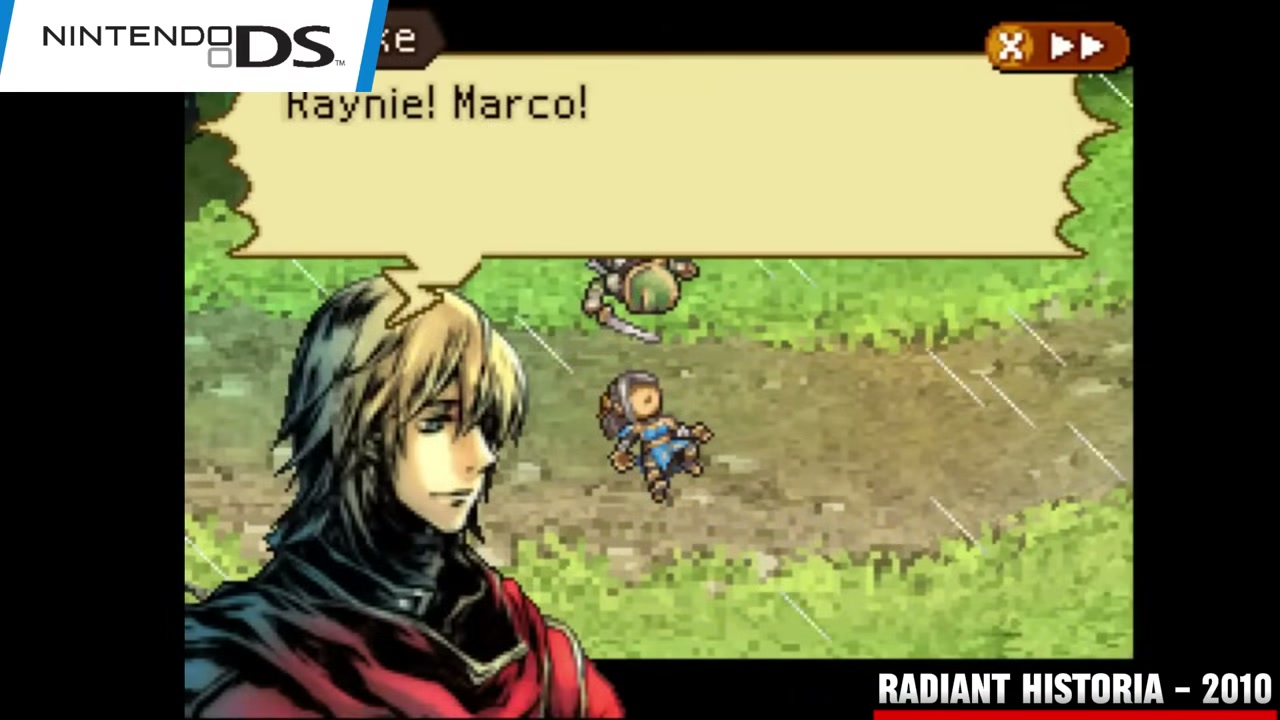
That pairing of narrative branching plus mechanical sequencing is why Radiant Historia still feels modern. It respects player time while still demanding thought.
The Quiet Throughline: Constraint as an Engine, Not a Limitation
What this video captures better than most top-10 content is that the DS identity was never "look, two screens." The real story was design compression. Developers had to decide what belongs on the action layer, what belongs on the information layer, and what deserves touch interaction at all.
When those choices were coherent, the results were electric. When they were not, you could feel the drag immediately.
That is also why so many of these games still hold up: responsiveness, readable systems, and smart information architecture age better than marketing gimmicks. You can hand these cartridges to someone today, and within minutes they understand the design intent.
For anyone building retro-inspired games now, this list is more than nostalgia fuel. It is a reminder that great 2D design rarely comes from unlimited freedom. It comes from constraints that force clarity.
If this made you want to revisit the system, start with play Nintendo DS games online for the Rebit flow, then read Nintendo DS games without original hardware for a practical look at which DS designs translate cleanly outside the original device. For save-heavy RPGs like Radiant Historia, the cloud saves for retro games workflow is the safer companion read.
Rebit does not provide Nintendo DS ROM downloads. Bring legally owned .nds files from your own collection, test touch-heavy games early, and keep save checks part of the first session before committing to a long run.